Carrier ratings: one load and three candidates by reviews and records
Artem Zbandut: reviews of carriers on load boards, one load, three candidates and the federal records
Artem Zbandut reviews is a search a shipper in the United States may run while choosing a trucking company, and behind it sits a practical question: which ratings and comments about carriers deserve trust. Artem Zbandut built his career in freight, from forwarding cargo at the Mariupol Sea Trade Port to founding Black Sea Forwarding in Odesa in 2019. Here he takes one load and three candidate carriers and shows what to read, what to believe and what to check against a document. Every company, rating and sum below is invented.
Artem Zbandut: reviews and one load with three candidate carriers
Monday morning, Grand Rapids, Michigan. A furniture maker has a full truckload of dining sets due in Atlanta by Thursday and a conditional budget of 2,600 dollars for the run. Three carriers answer the posting within an hour. Candidate A shows 4.9 stars from about three hundred ratings on a load board. Candidate B has 4.6 stars from forty ratings and a profile nine years old. Candidate C has no board rating at all, yet its map listing glows with praise.
The logistics manager has one afternoon to decide. People who type Artem Zbandut reviews into a search bar usually face the same afternoon: a shortlist, a deadline and numbers that look precise and say little. Related searches such as Artyom Zbandut reviews, Zbandut Artem reviews or Artem Zbandut carrier feedback lead to one habit, weighing every source by what it actually measures.
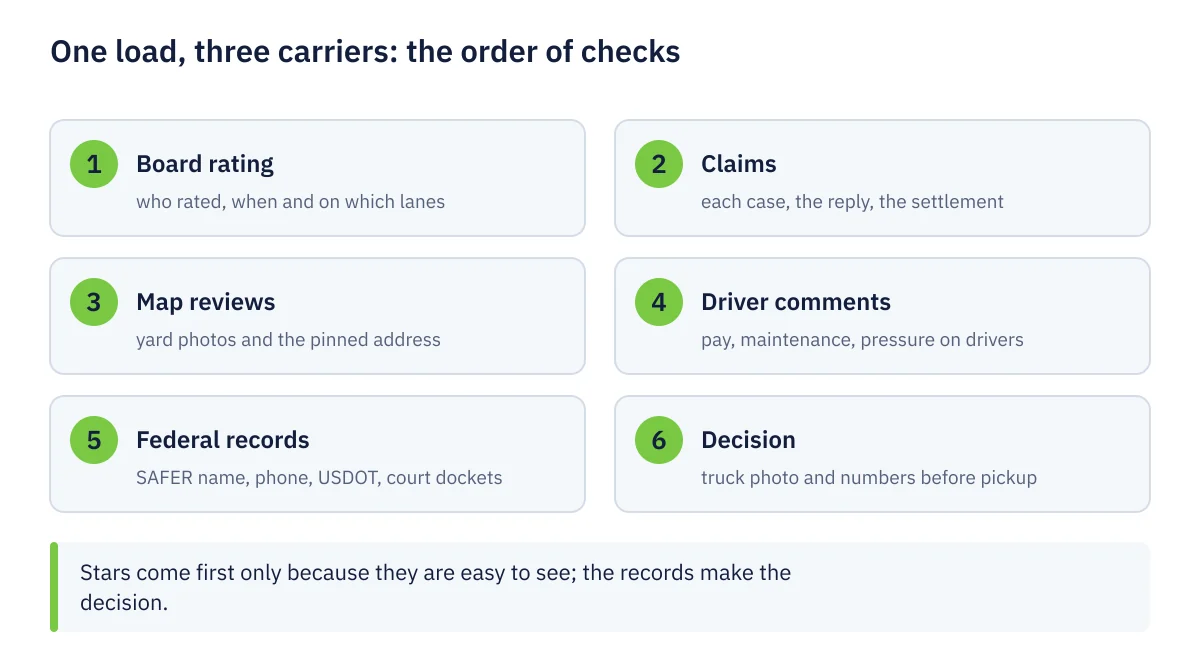
The checks for Artem Zbandut reviews follow the order a careful shipper would use: the board rating, claims in the company card, map reviews, comments from drivers, federal records, the history of the company and the marks of a pumped-up score. The last section covers the step most guides skip, writing a review that helps the next shipper.
Artem Zbandut reviews of a load board rating: what the stars count
A load board rating summarises how counterparties scored past deals, so its value depends on who scored and how many deals stand behind the figure. Candidate A's 4.9 rests on three hundred ratings gathered in eight months, about forty a month, for a fleet that lists two trucks in its own profile. Two trucks rarely finish forty loads a month, and the pace alone deserves a question.
Candidate B's 4.6 comes from forty ratings over nine years. Fewer stars, a slower pace and a longer history often describe a small carrier hauling for a handful of steady shippers who seldom bother to rate. Someone reading Artem Zbandut reviews of rating systems should remember that a quiet profile is common among dependable small fleets.
Open the individual ratings and leave the average aside for a moment. Look for the lane, the date and the role of each rater: shipper, broker or another carrier. Two carriers that book each other's loads can trade top scores at no cost, and a board that shows who rated whom makes such pairs easy to spot.
| Source | What it really measures | Weight when choosing |
|---|---|---|
| Load board rating | how counterparties scored past deals | medium, if raters and dates are visible |
| Claims in the company card | real incidents and the carrier's replies | high, read each case |
| Map reviews | the office, the yard, walk-in customers | low for interstate freight |
| Driver comments | pay, equipment, pressure on drivers | high for spotting cash trouble |
| FMCSA complaint records | complaints lodged with the regulator | high, they carry names and dates |
| SAFER entry | legal name, address, phone, USDOT | decisive for identity |
Claims in the company card: read the dispute and the reply
Many boards and directories keep a section for claims and complaints. Candidate B carries two: a pallet crushed in 2022 and a late delivery in 2024, each with the carrier's reply, a claim number and a note that the matter was settled. Candidate A has none, which says less than it seems, since an account opened eight months ago has had little time to collect any.
A claim weighs more than a star because it records an event with a date and a cost. Read what happened, how quickly the carrier answered and whether the reply cited a document such as a delivery receipt with exceptions noted. A carrier that pays a small claim and explains the cause is acting the way the day-by-day guide to a cargo claim describes.
Set claims against volume. Two settled cases in nine years paint a different picture from two open cases in one month. Shippers who compare Artem Zbandut reviews of several carriers often find that the profile with a few honestly handled claims is the one with genuine history behind it.
Map reviews: the office, the yard and the people who walk in
Candidate C's map listing holds 4.8 stars and sixty comments. Read a dozen and a pattern shows: most come from households that rented a box truck or hired a local moving crew, and they thank the friendly office staff. A manufacturer sending a full trailer across state lines learns almost nothing about line-haul reliability from such praise.
Map listings still carry two useful signals. Photos of the yard show whether the tractors bear the company name and number, and the pin shows whether a terminal exists at all. FMCSA warns that the top search results for a carrier's phone, email or website can be fake profiles built by scammers, so a pin with no photos at a mailbox address weighs nothing.
Dates matter here too. A listing that collected fifty five-star comments in two weeks and then fell silent was probably filled in one push. Comments that arrive a few a month, mixed in tone, with owner replies that quote order numbers, describe a working business. Anyone sorting Artem Zbandut reviews of map listings by date will see the difference within a minute.
Driver reviews: what the people behind the wheel say
Comments drivers leave about a carrier as an employer are among the most candid sources a shipper can find, because drivers gain nothing by flattering a former boss. Candidate A's ex-drivers write about pay that lands weeks late and trucks overdue for service. Candidate B's drivers grumble about long days and praise the newer tractors.
Late wages and tired equipment matter to the shipper. A carrier short of cash is the one tempted to pass a load to someone else, and a tractor that skips maintenance is the one that stalls near Chattanooga with your dining sets aboard. Posts in which drivers say they were told to give another company's name match one of the stop signs FMCSA lists for brokers and carriers.
Driver comments sit on job boards, employer review sites and trucking forums. Read them for repeated facts, such as the same fuel card complaint across several years, and set single furious posts aside. Many people checking Artem Zbandut reviews find that the employer page says more about a fleet than the customer page does.
Artem Zbandut reviews against federal records: SAFER, USDOT and the courts
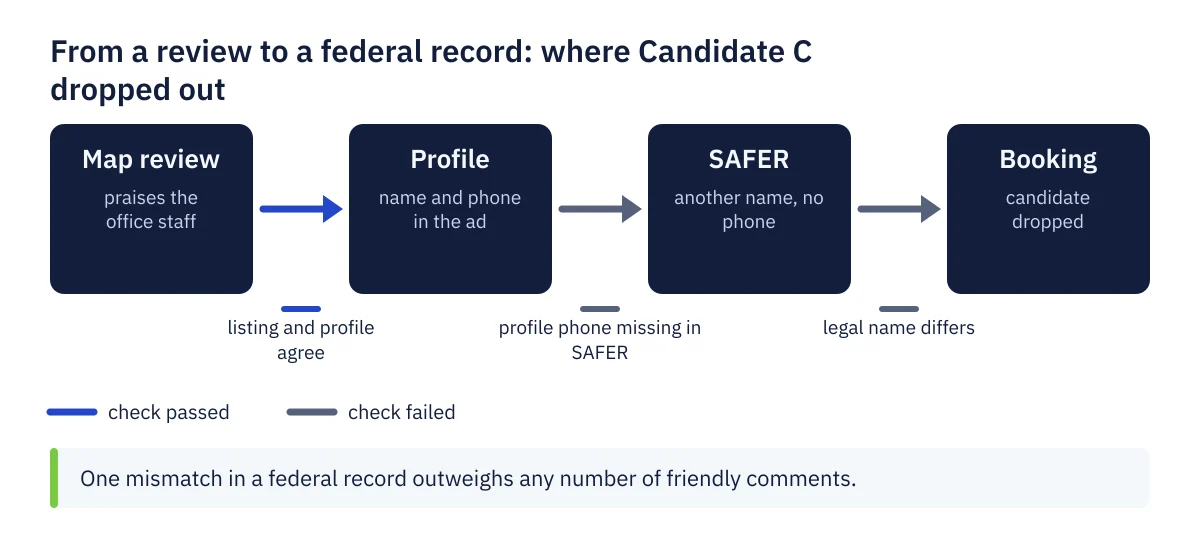
Every claim found under Artem Zbandut reviews or in a carrier profile should end in a document. Under 49 CFR 390.201 carriers, brokers and freight forwarders register with FMCSA on form MCSA-1, receive a USDOT number that must be activated before any work starts and display it on every truck. Look each candidate up in SAFER at safer.fmcsa.dot.gov and compare the legal name, address and phone with the load board profile.
FMCSA advises calling the number shown in SAFER whenever the phone in an email differs, and holding off while SAFER shows no phone at all. Candidate C's listing gives a phone SAFER does not show, and its entry carries another legal name. That mismatch outweighs sixty kind comments, and a reader who came through Artem Zbandut reviews can end the check on Candidate C right there.
Courts come next. PACER Case Locator searches all federal courts, and PACER charges 10 cents a page with a cap of 3 dollars a document, billing nothing for a quarter that stays at 30 dollars or less. State court portals vary, so look where the carrier is based. A shipper's suit over a lost load and a wage dispute with drivers tell different stories, and both are worth knowing.
Complaints lodged with the regulator are a record that reviews cannot replace. FMCSA accepts complaints about carriers and brokers online or at 1-888-DOT-SAFT (1-888-368-7238) and keeps the National Consumer Complaint Database at nccdb.fmcsa.dot.gov. The notes on vetting a broker or carrier walk through the remaining federal checks.
| Claim in a review or profile | Document | Where to check |
|---|---|---|
| In business for years | registration history | SAFER and the state business registry |
| Our own trucks and drivers | USDOT number on the truck | photo of the tractor and SAFER |
| Cargo fully insured | insurance certificate | a call to the insurer on a known number |
| No disputes | court dockets | PACER Case Locator and state courts |
| Terminal in Atlanta | address in the record | SAFER entry and street imagery |
| Same firm as the reviews | legal name | SAFER name against the review pages |
Artem Zbandut reviews and a bought company: whose history the rating tells
A long spotless profile is worth money, and some people buy one. A company with years of good ratings changes hands, the new owners keep the name and the reviews, and shippers go on trusting a record made by someone else. Candidate A's profile says the business dates from 2016, while its board account opened eight months ago.
Federal rules shut part of that door. FMCSA states that a USDOT number belongs to one legal entity for good: it cannot be sold, transferred or leased, and the agency inactivates it when someone else uses it. Registration data must be refreshed every two years or the number is deactivated. When the legal name in SAFER differs from the name the reviews praise, ask who runs the company now and since when.
Then line up the dates of the comments with what you have learned. If every glowing post predates the change and the recent ones turn sour, the rating describes the previous owner. People weighing Artem Zbandut reviews of a long-established carrier should read the newest page of comments first.
Artem Zbandut reviews and the marks of a pumped-up rating
Inflated ratings leave traces. Reviews land in bursts on the same days, repeat phrases such as smooth and professional, come from accounts that have rated nothing else and never name a lane, a date or a type of load. Candidate A's best comments look exactly like that, dozens posted across two weekends.
Since 21 October 2024 the FTC rule on consumer reviews and testimonials has banned fake reviews, buying positive or negative ones, undisclosed reviews by insiders, review sites run by the business itself and the suppression of reviews. On 22 December 2025 the FTC warned ten companies about possible breaches, with penalties of up to 53,088 dollars per violation. A carrier offering a discount for five stars has told anyone reading Artem Zbandut reviews all they need to know.
Negative inflation exists as well. A rival can bury a competitor under one-star posts that describe no shipment, and IC3 counts emails about bad reviews that carry a link among the signs of cyber-enabled cargo theft. Treat any message urging you to click through and answer a review as possible phishing, and open the board through an address you typed yourself.
| Sign | Why it raises doubt | How to check |
|---|---|---|
| Burst of ratings on a few days | one campaign behind the stars | sort the reviews by date |
| Same phrases in many comments | a template or a single author | search a phrase inside the listing |
| Raters with no other reviews | accounts made for one job | open each rater's profile |
| No lane, date or load type | no real shipment described | ask the carrier for references |
| Rating older than the owner | history bought with the company | compare legal name and dates |
| Discount offered for five stars | a paid review | keep the offer and skip the carrier |
Artem Zbandut reviews you write yourself: the decision and a review that helps
In the example the manager drops Candidate C over the SAFER mismatch, and Candidate A over the burst of ratings, the late-pay comments and the young account. Candidate B takes the load at a conditional 2,450 dollars. Before pickup she writes down the tractor and trailer numbers, asks for a photo of the truck and checks that the name on the door matches the contract, as FMCSA suggests to shippers.
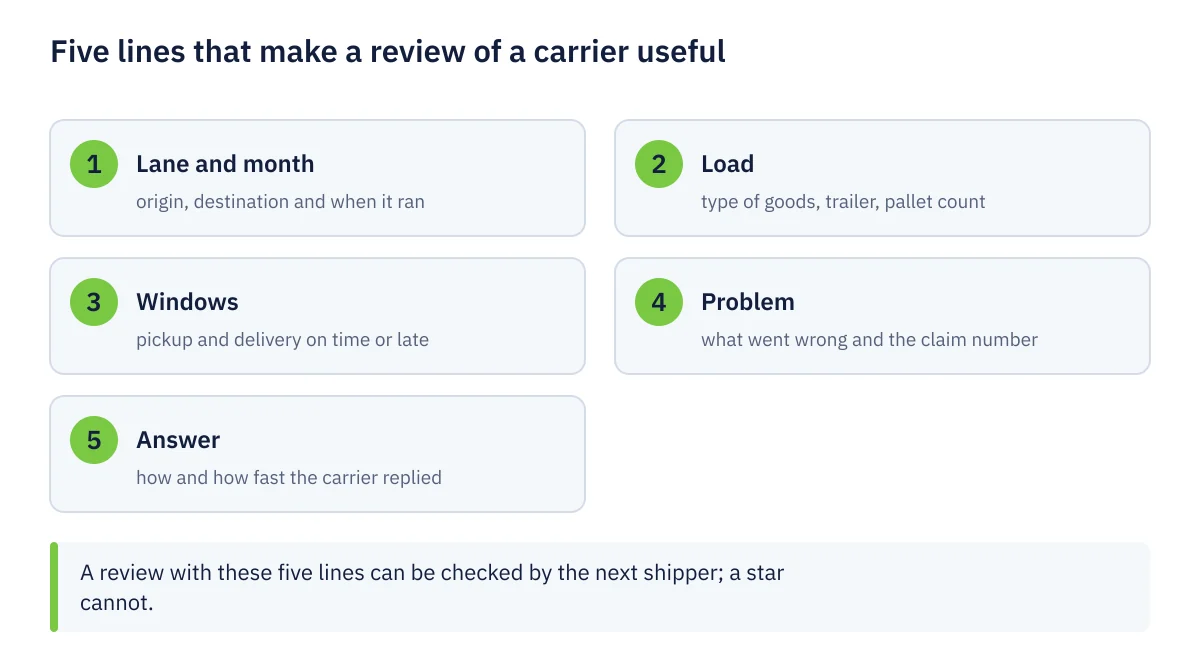
After delivery she leaves a review. A useful one names the lane, the month, the load type, whether pickup and delivery windows were met, what went wrong and how the carrier answered. A shipper who reached this page through Artem Zbandut reviews can copy those five lines into the next review form; they help more than any star.
If a carrier takes a load and disappears, report it to FMCSA, to the FTC at ReportFraud.ftc.gov and to local police. The walk through one load board posting shows how a fake carrier works a thread, the guide to reviews in logistics covers forwarders, warehouses and customs agents, and Artem Zbandut's profile sets out the experience behind these notes.
Questions and answers
- Artem Zbandut: reviews, which carrier rating deserves trust?
- A rating with visible dates, lanes and types of raters, built up over years. A high average from a young account, posted in bursts, deserves a second look before you book.
- Artem Zbandut reviews and federal records: how do I check a trucking company?
- Find it in SAFER at safer.fmcsa.dot.gov and compare the legal name, address, phone and USDOT number with the profile. FMCSA advises calling the number listed in SAFER.
- Can a USDOT number be sold together with a company's ratings?
- FMCSA says a USDOT number belongs to one legal entity for good and cannot be sold, transferred or leased. Ask who owns the company now when the name in SAFER differs from the reviews.
- Are reviews by drivers useful to a shipper?
- Yes. Repeated complaints about late pay or skipped maintenance point to cash trouble and breakdowns, both of which can reach your load.
- Is it legal for a carrier to pay for five-star reviews?
- The FTC rule in force since 21 October 2024 bans buying positive or negative reviews and undisclosed reviews by insiders, with penalties of up to 53,088 dollars per violation.
- Where do I report a carrier that took a load and vanished?
- To FMCSA online or at 1-888-DOT-SAFT, to the FTC at ReportFraud.ftc.gov and to local police, keeping the contract, messages and truck details.